
NewVolt breaks ground on national fast charging network for electric trucks
With $25.3 million in ARENA co-funding announced today and construction under way in Melbourne’s west, NewVolt is turning years of development and industry engagement into the infrastructure solution Australia’s freight industry needs right now.
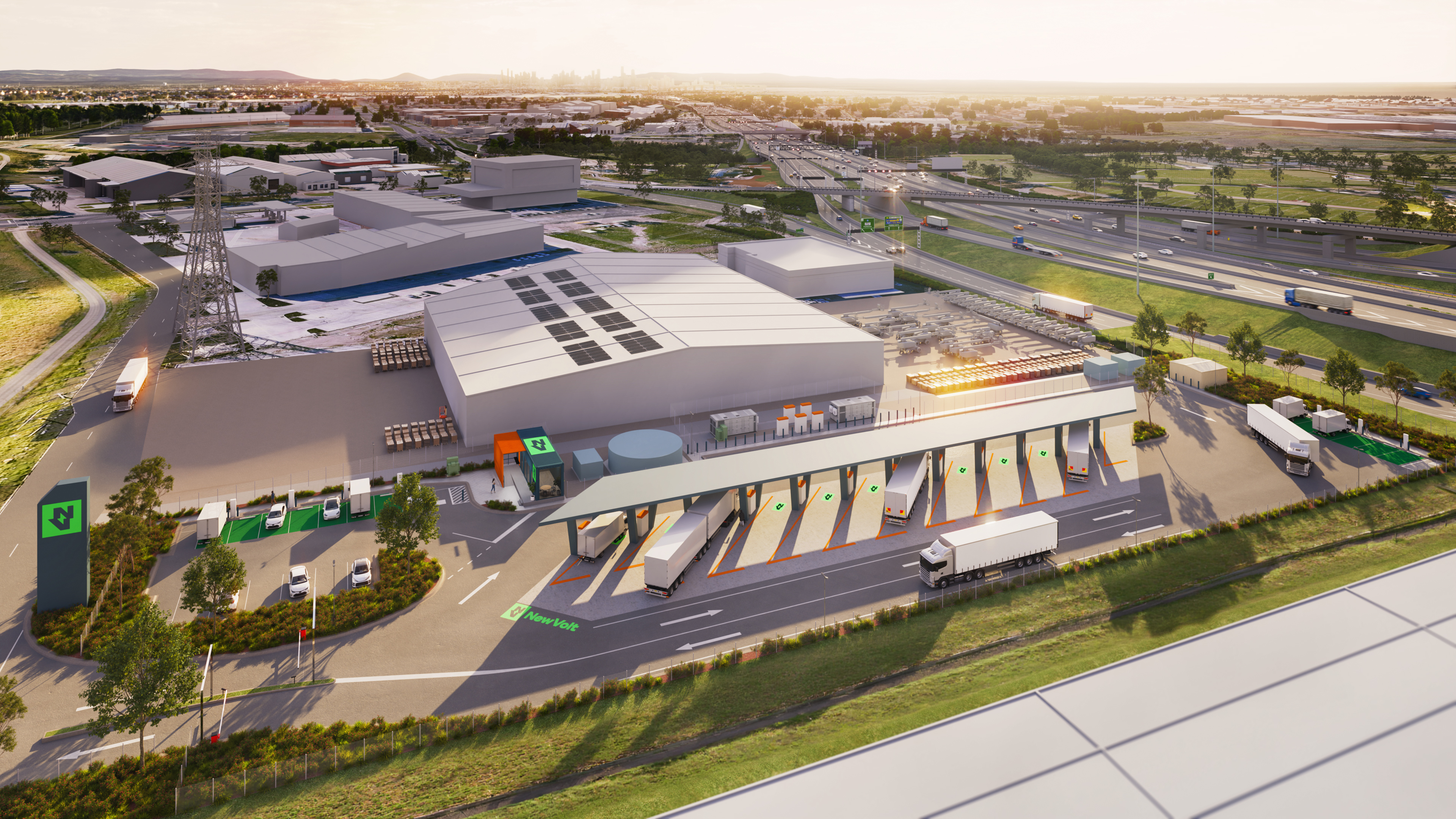
Melbourne, Australia — NewVolt today confirmed it is building Stage 1 of the NewVolt Network, a three-hub, open-access fast-charging network for electric trucks serving Melbourne’s major freight precincts. The announcement comes as the Australian Renewable Energy Agency (ARENA) formally announced $25.3 million in co-funding for the project in Canberra — backing that NewVolt says is already being put to work.
Australia’s road freight industry runs almost entirely on imported diesel — a fuel that costs the economy roughly $30 billion a year. That structural vulnerability has become an acute crisis: as of late March 2026, Australia holds just 30 days of diesel — less than a third of the IEA’s 90-day requirement — with over 100 service stations across New South Wales running dry following the closure of the Strait of Hormuz. Retired Air Vice-Marshal John Blackburn AO, who has warned of this risk for over a decade, described Australia as “sleepwalking into a national crisis.” He is right. While energy security has risen sharply up the national agenda, NewVolt’s position is straightforward: the answer is not another policy paper. It is infrastructure, in the ground, now.
“Australians are suddenly very aware of our energy insecurity and the pain we feel from dependence on imported energy. Australia has the renewable energy resource, and now the trucks, to remove that dependence. Every electric truck on Australia’s roads, charging on Australian renewable energy, adds resilience to our supply chains. The NewVolt Network is a foundation for that resilience.”
Anthony Headlam, CEO & Co-Founder, NewVolt
A national network, starting in Melbourne.
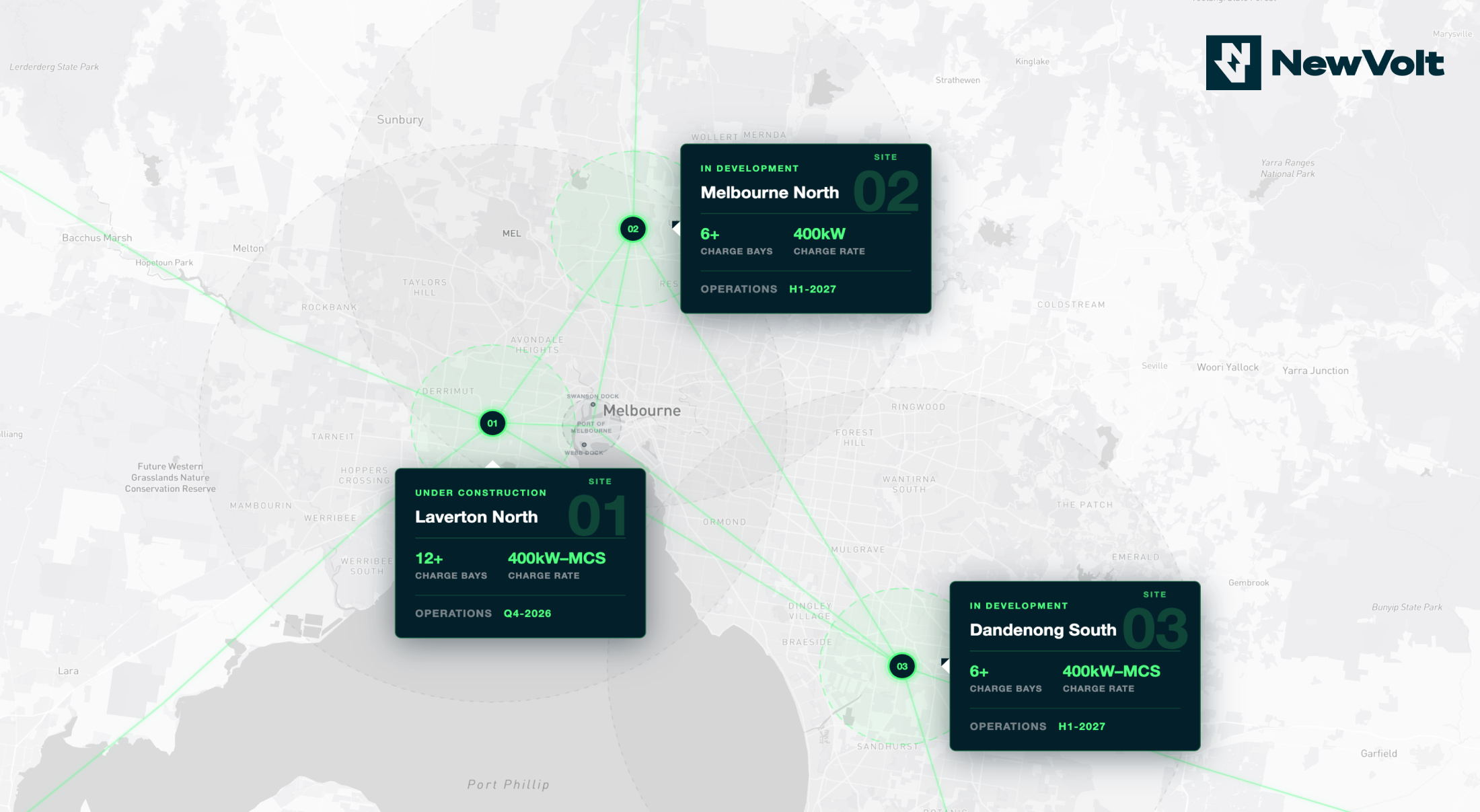
Stage 1 of the NewVolt Network — funded with the support of ARENA — will deliver three strategically located charging hubs across greater Melbourne: Melbourne West (Laverton North), Melbourne North (Campbellfield/Somerton), and Melbourne South-East (Dandenong South). Together, the sites cover the city’s three principal freight precincts, provide open-access fast charging for both foundation fleet customers and the broader market.
Civil construction is already under way at Site 1 in Laverton North. The first bays are targeted to be operational in late 2026, with the full network delivering across all three sites through 2027. The hubs will provide scheduled, price-certain fast charging — with power up to 400kW per bay with dual-plug capability — purpose-built for heavy and medium commercial trucks rather than adapted from passenger vehicle infrastructure. NewVolt is also exploring the integration of Megawatt Charging Standard (MCS) capability from opening, which would make the NewVolt Network one of the first commercial truck charging networks in Australia to offer MCS-ready infrastructure.
“Australia just realised it has 30 days of diesel. We didn’t found NewVolt to write reports about that problem — we founded it to build the infrastructure that solves it. That’s what’s parked on a construction site in Laverton North right now.”
Rainer Knobloch, CSOO & Co-Founder, NewVolt
Bringing down the cost of going electric.
One of the most persistent barriers to electric truck adoption is upfront cost. Included in the $25.3 million in ARENA co-funding, is approximately $10 million specifically to bridge the total cost of ownership (TCO) gap for foundation fleets — bridging the remaining gap between the cost of an electric truck and its diesel equivalent today.
As a network customer, operators also receive price-certain access to charging infrastructure, locking in the economics of switching from diesel with contractual certainty — not at some hypothetical future parity date.
NewVolt is also developing a bundled truck and charging product, enabling operators — particularly smaller and mid-sized fleets who lack the balance sheet to absorb large capital outlays — to access electric trucks and NewVolt network credits as a single, integrated commercial package. The goal is to remove every practical obstacle between a freight operator and their first electric truck.
The project also includes direct support for between 50 and 100 electric trucks operating heavy freight across greater Melbourne — the largest supported electric truck deployment in Australian history.
“The trucks are available. The business case keeps getting better. What operators have needed is a network they can rely on, and a commercial model that works for them so they can start their transition confidently.”
Anthony Headlam, CEO & Co-Founder, NewVolt
Seven years in the making.
NewVolt was founded in 2019 — before a single commercially viable heavy electric truck was available in Australia. Co-founders Anthony Headlam, Rainer Knobloch, and Andy Evans identified early the opportunity for Australia to take advantage of its abundant renewable energy resources to deliver lower cost road freight and energy security for Australia. The NewVolt Network represents foundational infrastructure to help unlock that opportunity: fast charging that purpose-built for trucks, offered in a scheduled basis with price certain contracts. The network delivers Australian renewable energy to power the road freight task.
That conviction that the transition to electric trucks was inevitable has been tested across years of site development and market-building with freight operators who are challenged by low margins and a low tolerance for risk in a highly competitive market. In the absence of any regulatory imperative, it has been slower for electric trucks to gain traction. Today they are accepted in Australia as the decarbonisation pathway and there is broad recognition of the better economics they can deliver for fleets.
The ARENA funding, secured after a rigorous multi-stage submission process, validates both the model and the market.
Melbourne first. Then the nation.
Stage 1 in Melbourne is the first step in a planned national network of 60-plus sites, spanning Sydney, Brisbane, and electrification of the Hume Highway corridor, alongside the Pacific, Newell, Sturt and Western Highways. NewVolt has has identified and is progressing multiple sites along the Hume Highway corridor, and co-leads the HumeZero initiative alongside CALSTART’s Drive to Zero programme, which was added to the Global Green Road Corridors initiative at COP30, in Belem, Brazil in November 2025.
The phased build-out — 14 sites by 2027, 40 by 2032, 60 by 2040 — is designed to match the pace of electric truck market development, with each phase reinforcing demand for the next. Melbourne’s network provides the operational proof of concept, the delivery partnerships, and the customer relationships that the national rollout will be built upon.
“Seven years ago we said Australia would need this network. We were told the market wasn’t ready. We started building it anyway. The market is ready.”
Rainer Knobloch, COO & Co-Founder, NewVolt
Media Contacts
Anthony Headlam — CEO & Co-Founder
hello@newvolt.com.au | newvolt.com.au
Rainer Knobloch — COO & Co-Founder
hello@newvolt.com.au | newvolt.com.au
Notes to Editors
• ARENA’s $25.3 million co-funding for Stage 1 of the NewVolt Network was announced in Canberra on 30 March 2026 under ARENA’s Driving the Nation Program.
• Stage 1 of the NewVolt Network comprises three open-access, fast-charging hubs in Melbourne’s west (Laverton North), north (Campbellfield/Somerton) and south-east (Dandenong South).
• Civil construction has commenced at Site 1, Laverton North. The first site is targeted to open in late 2026; remaining hubs are targeted for delivery through 2027.
• NewVolt Infrastructure Pty Ltd was founded in 2019 and is headquartered in Melbourne, Australia.
• Australia’s road freight sector consumes approximately $30 billion in imported diesel annually (Australian Petroleum Statistics).
• NewVolt’s planned national network spans 60-plus sites across Melbourne, Sydney, Brisbane, and the Hume Highway corridor.